

The gaming industry has evolved beyond entertainment, creating legitimate opportunities for players to generate substantial income. Whether you're a casual mobile gamer or a dedicated console enthusiast, multiple pathways exist to earn money playing games while doing what you love. The key lies in understanding which methods align with your skills, available time, and gaming preferences. This comprehensive guide explores proven strategies that transform gaming sessions into revenue-generating activities.
Understanding the Gaming Income Landscape
The global gaming economy has expanded dramatically, creating diverse monetization opportunities for players at every skill level. Unlike traditional employment, gaming income streams offer flexibility and scalability that appeal to anyone seeking additional revenue sources.
Market Growth and Opportunities
The gaming industry generated over $200 billion in revenue during 2025, with a significant portion flowing to individual players through various channels. This economic expansion has legitimized gaming as a viable income source rather than merely a recreational activity.
Key factors driving this growth include:
- Increased platform accessibility across mobile, console, and PC gaming
- Rising demand for gaming content and entertainment
- Expansion of esports and competitive gaming circuits
- Development of blockchain-based gaming economies
- Creator-focused monetization tools from major platforms
Professional gamers now earn six-figure incomes, while part-time players supplement their earnings with hundreds or thousands of dollars monthly. The spectrum of opportunities accommodates different commitment levels and skill sets.
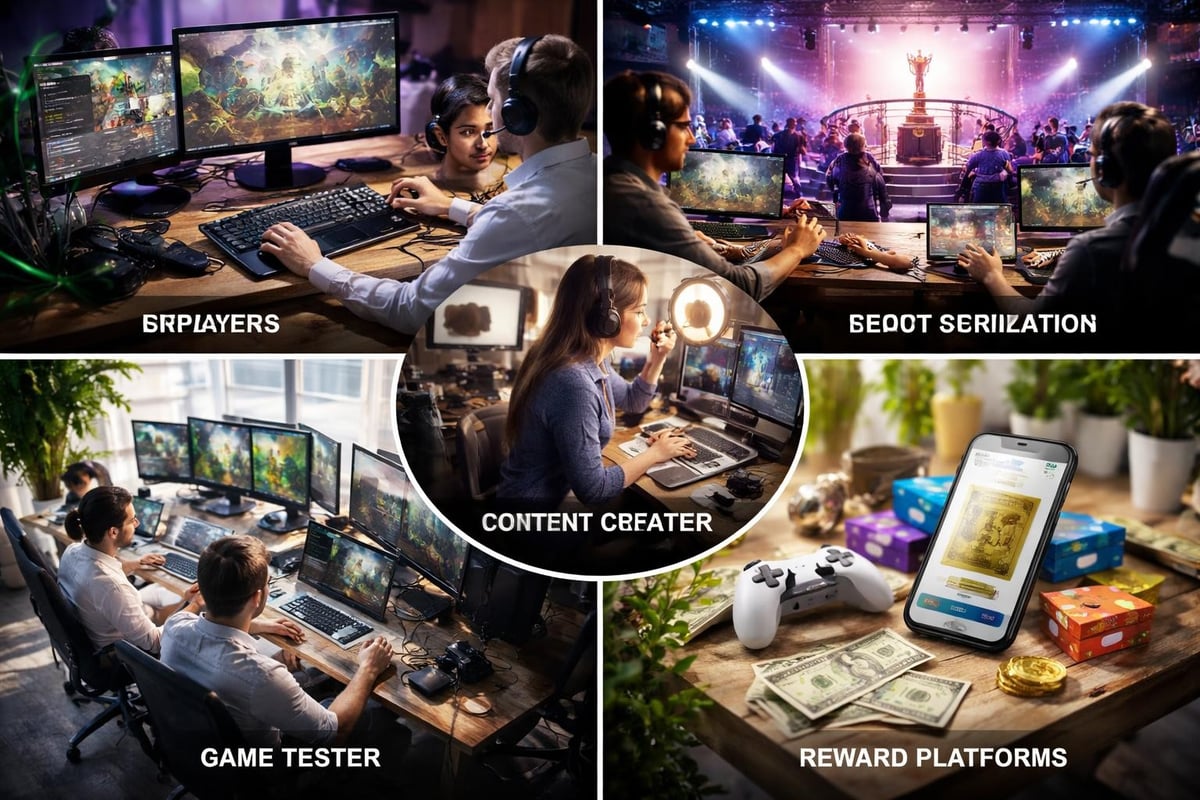
Streaming and Content Creation Platforms
Broadcasting your gameplay represents one of the most accessible methods to earn money playing video games. Platforms like Twitch, YouTube Gaming, and Facebook Gaming enable players to build audiences and monetize through multiple revenue streams simultaneously.
Building Your Streaming Foundation
Successful streamers combine entertainment value with gaming skills, creating content that attracts and retains viewers. You don't need professional equipment initially, but consistency and personality matter significantly.
| Platform | Revenue Methods | Typical Starting Point |
|---|---|---|
| Twitch | Subscriptions, bits, ads, donations | Affiliate status (50 followers) |
| YouTube Gaming | Ad revenue, memberships, Super Chats | Monetization eligibility (1,000 subscribers) |
| Facebook Gaming | Stars, subscriptions, ads | Level Up program entry |
Starting requires basic streaming software, a decent internet connection, and regular broadcast schedules. Most successful streamers dedicate 15-20 hours weekly to build initial momentum.
Revenue diversification separates sustainable streamers from those who burn out quickly. Combining platform payments with sponsorships, merchandise sales, and affiliate marketing creates stability as your audience grows.
Content Strategy Development
Your streaming success depends on identifying your unique angle within the crowded gaming content space. Specialization often outperforms general gaming content when building dedicated audiences.
Consider these differentiation strategies:
- Focus on specific game genres or titles
- Develop educational content teaching advanced techniques
- Create entertaining personalities or character-driven streams
- Emphasize community interaction and viewer engagement
- Combine gaming with other interests or expertise
The practical methods to earn money by playing video games include streaming as a foundational approach that complements other income strategies.
Competitive Gaming and Esports Tournaments
Tournament participation offers performance-based earnings for skilled players. The esports ecosystem now includes competitions for virtually every major game title, with prize pools ranging from hundreds to millions of dollars.
Tournament Types and Entry Points
Competitive gaming opportunities exist at multiple tiers, from local community events to international championships. Understanding this hierarchy helps you identify appropriate starting points.
Amateur tournaments typically feature entry fees between $5-50 with prize pools distributed among top performers. These events provide valuable experience while offering realistic earning potential.
Semi-professional circuits require higher skill levels but offer substantial rewards. Regional competitions frequently distribute $10,000-100,000 across winners, with monthly or quarterly schedules.
Professional esports represents the pinnacle, where top performers earn salaries, bonuses, and prize money totaling millions annually. Reaching this level demands exceptional skill and dedication.
Google's Free Fire League initiative demonstrates how major platforms now support competitive gaming through rewards and recognition systems.
Skill Development and Team Building
Success in competitive gaming requires systematic improvement and often team coordination. Solo practice develops individual mechanics, while team practice builds communication and strategy execution.
Invest time in analyzing professional matches, studying meta-game developments, and receiving coaching when possible. Many successful tournament players dedicate 4-6 hours daily to deliberate practice focused on specific skill improvements.
Gaming Reward Platforms and Apps
Several legitimate platforms compensate players for gaming activity, though earning potential varies significantly. These systems typically reward engagement through points convertible to cash or prizes.
Evaluating Platform Legitimacy
The gaming rewards space includes both genuine opportunities and deceptive schemes. Recent incidents, including Freecash’s removal from the Apple App Store, highlight the importance of thorough research before investing time.
Legitimate platforms display these characteristics:
- Clear, transparent payment structures
- Established track records with verified user testimonials
- Reasonable earning expectations without exaggerated claims
- Responsive customer support
- Accessible payout methods
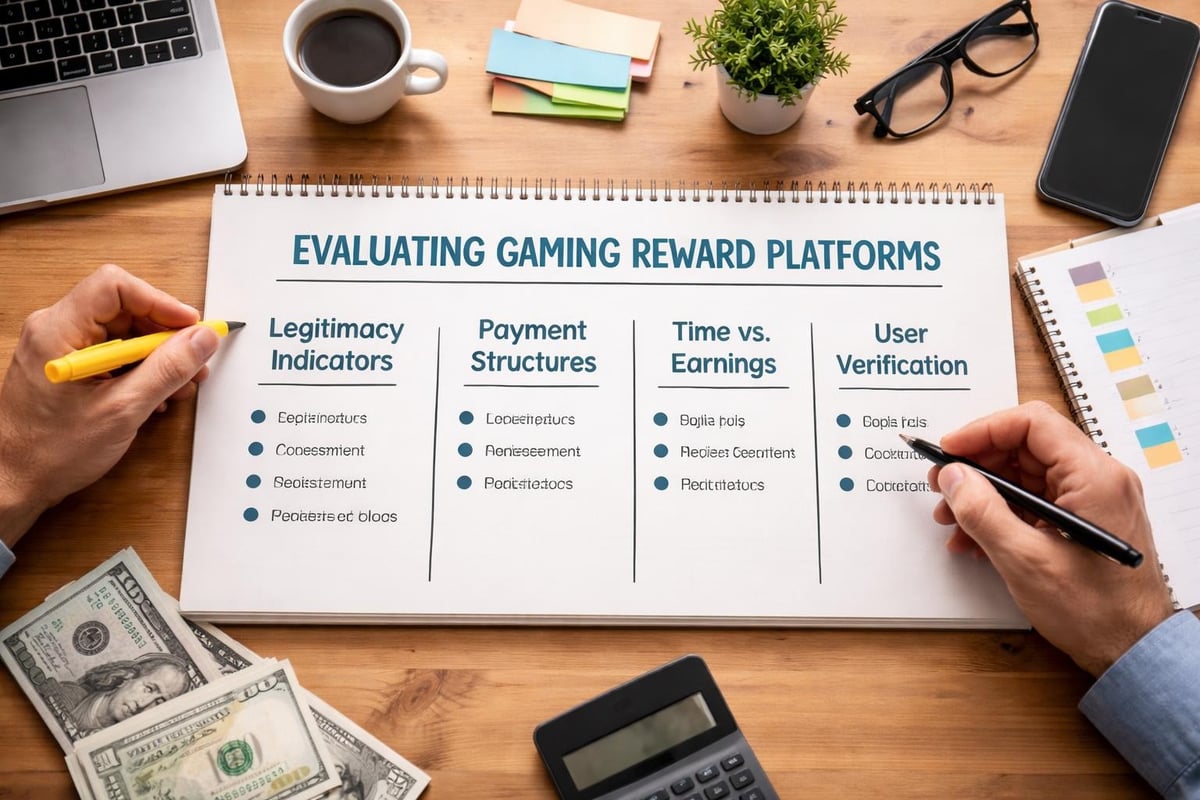
Research legitimate ways to make real money from playing games before committing significant time to any platform. Verify payout histories and user experiences through independent reviews.
Maximizing Reward Platform Earnings
Strategic approach maximizes returns from gaming reward systems. Focusing efforts on high-value activities and understanding platform mechanics significantly impacts earnings.
| Strategy | Implementation | Expected Impact |
|---|---|---|
| Daily engagement bonuses | Complete daily login rewards | 20-30% earnings increase |
| Referral programs | Invite active gaming friends | Variable passive income |
| High-value game selection | Prioritize top-paying titles | 40-50% efficiency gain |
| Event participation | Join limited-time challenges | 2-3x temporary multipliers |
Most reward platforms generate $20-100 monthly for casual players, with dedicated users occasionally reaching $200-500. These earnings work best as supplementary income rather than primary revenue sources.
Game Testing and Quality Assurance
Professional game testing represents a structured employment opportunity to earn money playing games before public release. Testing roles combine gaming with analytical feedback, bug identification, and quality documentation.
Breaking Into Game Testing
Entry-level testing positions typically require no formal qualifications beyond attention to detail and clear communication skills. Companies hire testers for contract projects lasting weeks to months.
Testing work involves repetitive gameplay focused on specific features or areas rather than entertainment-oriented playing. Testers systematically document issues, reproduce bugs, and verify fixes across multiple iterations.
Compensation typically ranges:
- Entry-level testers: $15-20 per hour
- Experienced QA analysts: $25-40 per hour
- Senior QA leads: $50-75 per hour
Remote testing opportunities have expanded significantly, allowing geographic flexibility for qualified candidates. Building relationships with testing companies provides access to consistent project flows.
Advancing Your Testing Career
Experienced testers transition into specialized roles focusing on specific technical areas or advancing to project management positions. Certification programs and technical skill development accelerate career progression.
Consider these advancement pathways:
- Automation testing requiring programming knowledge
- Localization testing for multiple languages
- Compatibility testing across devices and platforms
- User experience research and analysis
- Production coordination and project management
Creative Monetization Through In-Game Economies
Modern games increasingly feature creator-driven economies where players earn money playing through asset creation, trading, and commerce. These opportunities combine gaming skills with entrepreneurial thinking.
Platform-Specific Creator Programs
Major gaming platforms now offer monetization tools for creators who develop custom content. Fortnite’s expansion of creator monetization through island-based item sales exemplifies this growing trend.
Successful creators generate income through:
- Custom map and mode creation with revenue sharing
- Cosmetic item design and marketplace sales
- Player-created challenges and competitions
- Educational content and tutorial creation
- Community management and event hosting
These opportunities reward creativity and community building alongside gaming proficiency. Initial earnings typically start modestly but scale significantly with audience growth and content quality improvements.
Trading and Virtual Economies
Certain games support robust trading economies where rare items, accounts, or in-game currency hold real-world value. Players profit through strategic acquisition, market timing, and value arbitrage.
Popular trading-focused games include:
- Counter-Strike 2 (weapon skins and cases)
- Rocket League (cosmetic items and blueprints)
- Various NFT-based blockchain games
- MMORPGs with player-driven economies
Successful traders develop market knowledge, understand supply-demand dynamics, and manage risks associated with value fluctuations. Treating virtual trading as serious business rather than gambling produces consistent results.
Building Multiple Gaming Income Streams
Sustainable gaming income rarely relies on single revenue sources. Strategic diversification creates stability while maximizing earning potential across various opportunities to earn money playing.
Portfolio Approach to Gaming Income
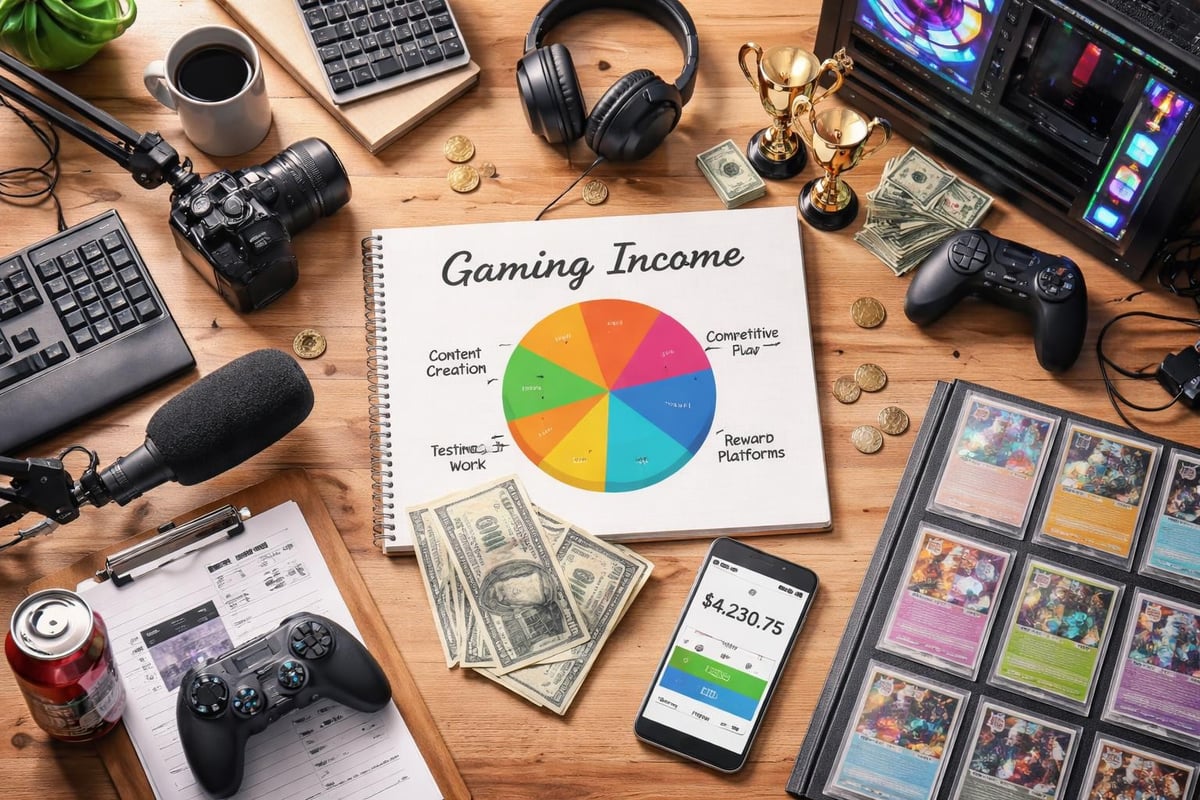
Professional gaming entrepreneurs typically maintain 3-5 simultaneous income streams that complement rather than compete for time and attention. This approach provides stability when individual channels fluctuate.
Example diversified portfolio:
- Primary stream: Content creation (15 hours weekly)
- Secondary stream: Tournament participation (10 hours weekly)
- Passive income: Reward platform engagement (5 hours weekly)
- Occasional income: Game testing projects (variable)
- Investment activity: Trading in-game economies (2-3 hours weekly)
Time allocation shifts based on seasonal opportunities, personal skill development, and market conditions. Flexibility allows capitalizing on high-value opportunities while maintaining baseline income.
Scaling Strategies Over Time
Initial gaming income typically starts with lower-barrier opportunities while building skills and audiences for higher-value channels. Strategic progression accelerates income growth beyond linear time-for-money exchanges.
12-month progression example:
- Months 1-3: Reward platforms and casual streaming ($100-300/month)
- Months 4-6: Consistent content creation and amateur tournaments ($300-800/month)
- Months 7-9: Sponsorship development and advanced competitions ($800-2,000/month)
- Months 10-12: Diversified portfolio with passive elements ($2,000-5,000/month)
These timelines assume consistent effort, strategic learning, and market-appropriate expectations. Individual results vary based on game selection, skill development rates, and market positioning.
Tax Considerations and Business Structure
Gaming income constitutes taxable revenue requiring proper reporting and potential business structuring. Understanding tax obligations prevents future complications while maximizing legitimate deductions.
Income Classification and Reporting
Gaming earnings fall into different tax categories depending on their source and structure. Properly classifying income ensures compliance while optimizing tax treatment.
| Income Source | Tax Classification | Reporting Method |
|---|---|---|
| Tournament prizes | Prize income | Form 1099-MISC |
| Streaming revenue | Self-employment income | Schedule C |
| Testing contracts | Contract labor | Form 1099-NEC |
| Reward platforms | Miscellaneous income | Various (platform dependent) |
Maintain detailed records of all gaming-related income and expenses throughout the year. Documentation supports deductions and provides audit protection if questioned.
Deductible Gaming Expenses
Operating a gaming business creates numerous legitimate deductions reducing taxable income. Track these expenses consistently for tax benefit maximization.
Common deductible expenses include:
- Gaming equipment and hardware purchases
- Internet and utility costs (proportional use)
- Software subscriptions and game purchases
- Home office space (if qualifying)
- Marketing and promotional costs
- Professional development and training
Consult with tax professionals familiar with digital income streams for personalized guidance. Business structure decisions (sole proprietor versus LLC) impact both tax treatment and liability protection.
Risk Management and Realistic Expectations
Approaching gaming income opportunities with clear-eyed realism prevents disappointment while enabling strategic decision-making. Understanding both potential rewards and inherent limitations creates sustainable approaches.
Time Investment Versus Return Analysis
Gaming income opportunities vary dramatically in efficiency, with some methods generating $5-10 hourly while others potentially exceed $100 hourly for skilled practitioners. Honest assessment guides optimal time allocation.
Calculate your effective hourly rate by dividing total earnings by time invested, including preparation, practice, and administrative tasks. This metric reveals which activities deserve continued focus versus reallocation.
Most beginners earn less than minimum wage initially while building skills and audiences. Patience during this development phase separates those who build sustainable income from those who quit prematurely.
Avoiding Common Pitfalls
New gaming entrepreneurs frequently encounter predictable obstacles that derail progress. Awareness of these challenges enables proactive mitigation strategies.
Watch for these warning signs:
- Unrealistic income expectations leading to premature quitting
- Spreading effort across too many simultaneous opportunities
- Neglecting skill development in favor of constant content production
- Ignoring tax obligations until they become overwhelming
- Falling for scam platforms promising unrealistic returns
The comprehensive overview of methods to earn money by playing games emphasizes both opportunities and realistic expectations for sustainable success.
Transforming your gaming passion into meaningful income requires strategic planning, consistent effort, and realistic expectations about timelines and returns. The opportunities to earn money playing games have never been more accessible or diverse, spanning from casual reward platforms to professional esports careers. Make Extra Money Academy provides the comprehensive tools, expert strategies, and step-by-step guidance you need to navigate these opportunities effectively and build sustainable gaming income streams. Explore our resources at Make Extra Money Academy to accelerate your journey from casual player to profitable gaming entrepreneur.